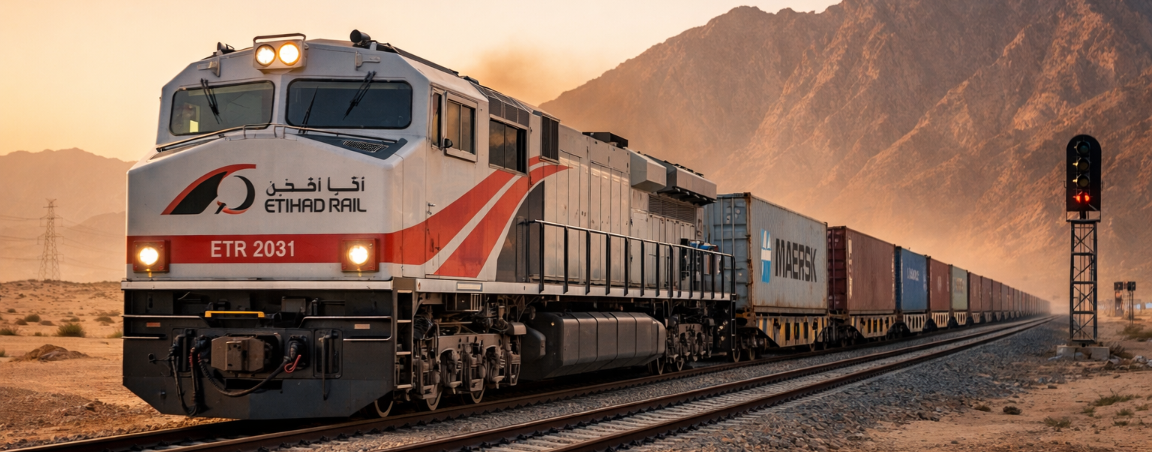
Etihad Rail and the Evolution of GCC Logistics in Times of Disruption
Periods of geopolitical tension place immediate pressure on logistics networks. Routes shift, lead times become less predictable, and capacity is tested across the system. In such moments, the true strength of infrastructure becomes visible, not in theory, but in execution.
In the UAE, recent developments have highlighted the growing role of Etihad Rail as a stabilising component of the national supply chain. While parts of the region experienced operational strain, rail continued to provide a consistent and controlled channel for freight movement across the country.
According to recent reports, Etihad Rail operated over 100 freight train trips within a short period, moving hundreds of thousands of tonnes of cargo and thousands of containers across its network. This was not only a demonstration of capacity, but of reliability under pressure, which is arguably the most critical metric in logistics during uncertain times (Khaleej Times).
What this moment reveals is not simply the effectiveness of rail as an alternative mode of transport, but its role as a structural layer within the logistics ecosystem. Unlike road transport, which is inherently exposed to variability ranging from driver availability to border conditions, rail operates within a more controlled environment. It offers predictability in transit times, higher volume capacity, and reduced exposure to operational disruptions.
This distinction becomes particularly important when supply chains are under stress. The ability to move large volumes of cargo in a stable and scheduled manner allows shippers to maintain continuity, even when parts of the system are under strain. In this sense, rail is not replacing other modes, but reinforcing the overall resilience of the network.
Looking beyond the current situation, it is reasonable to expect that this period will influence how logistics decisions are made going forward. Once reliability has been demonstrated under real conditions, it tends to reshape perception. Rail is likely to transition from being viewed as a complementary option to becoming a more central component of freight strategies, particularly for high volume and port to inland movements.
At the same time, the expansion of rail does not diminish the role of trucking. On the contrary, it introduces a shift in how trucking is utilised. Rather than focusing primarily on long haul movements, trucking operations are expected to become more integrated with rail, handling first mile and last mile segments with greater efficiency. This creates a more structured intermodal system, where each mode operates within its area of strength.
The UAE’s rail network, which already connects key ports and industrial zones across approximately 900 kilometres, is also part of a broader regional vision. Projects linking the UAE to Oman and the wider GCC are progressing, suggesting that the role of rail will extend beyond national borders over time. As these connections develop, the implications for trade flows and logistics planning will become increasingly significant.
What is emerging is a more layered logistics environment. Instead of relying heavily on a single mode of transport, supply chains are evolving toward a model where multiple modes are combined and coordinated. This not only improves resilience, but also opens opportunities for optimisation in cost, transit time, and capacity utilisation.
In this context, the role of digital platforms becomes more relevant. As logistics networks grow more complex, the ability to orchestrate movements across different modes, carriers, and routes becomes essential. Visibility, coordination, and data driven decision making are no longer optional. They are required to fully leverage the infrastructure being built.
The recent performance of Etihad Rail provides a clear indication of where the market is heading. It reflects a shift toward more structured, integrated, and resilient logistics systems across the UAE and the wider GCC. While the immediate impact has been to support supply continuity during a period of disruption, the longer term effect is likely to be a sustained increase in adoption and a rebalancing of how freight moves across the region.
In that sense, this moment is less about disruption, and more about acceleration.